

📚 Background
The problem was embarrassingly simple: EthanC trades options and stocks regularly but had no reliable picture of actual profit and loss.
Records lived in three places simultaneously — broker transaction history, manual notes, and Excel sheets that gradually became more optimistic than accurate. Answering a basic question like "what's my win rate this month?" required cross-referencing all three, doing mental arithmetic, and hoping the numbers added up.
Well, the numbers do – but after significant effort and time.
Excel was the obvious solution. Excel was also the problem. Manual entry is tedious, validation is non-existent, and computing analytics consistently across an evolving spreadsheet is exactly as fun as it sounds. One formula error or one data entry error, and the whole thing lies to you confidently.
Motoko-chan and EthanC asked the obvious question: why are we doing this manually when we could just build the right tool?
Three days later, OptionsWaifu existed.
Phase 1 — Local Trade Tracking System
🎯 Objectives
Build a simple, fast, local options trade tracker that actually answers the questions that matter:
- How much profit did I make this month?
- Which tickers are performing best?
- What is my win rate?
- What is my return on capital?
Not a commercial product. Not a SaaS platform. A personal engineering tool, built in days, that replaces scattered Excel sheets and broker transaction histories with one clean local system.
Constraint: finished in days, not weeks. No over-engineering.
💡🤔 Design Philosophy
The system had one job: be finished and usable within days. Every design decision was made through that lens.
| Decision | Rationale |
|---|---|
| Local-only | Full control, no subscriptions, no data sharing |
| SQLite | Simple, persistent, zero infrastructure |
| No deletion | Trades are ignored, not deleted — data integrity preserved |
| React + Vite frontend | Fast to generate, easy to iterate |
| Node.js + Express backend | Straightforward API layer |
| Prisma ORM | Clean schema management |
| No over-engineering | Phase 1 must ship. Phase 2 can be clever. |
The "no deletion" decision deserves a mention — ignored trades are hidden from the UI but preserved in the database. Every trade that ever happened stays in the record. Future analytics will thank us for this.
🛠️ Development Approach
This project introduced a new division of labor across the AI-chan team:
Motoko-chan handled system architecture, database design, backend API planning, and debugging. She designed the data model and kept the overall structure coherent.
Lovable-chan handled the React UI — forms, tables, filters, analytics display, layout. She produced a working frontend prototype in minutes.
EthanC defined requirements, tested features, ran commands, validated results, and made the final calls on everything. Also responsible for all suffering that occurred regardless of cause. And also... spent days migrating the data onto the DB... zzzz
This was the first project where the frontend and backend were handled by different AI collaborators simultaneously. It worked surprisingly well — when each tool was given a clearly scoped job.
The lesson Motoko-chan keeps repeating: clear requirements produce clear results. Vague requirements produce creative interpretations of vague requirements.
⚙️ System Architecture
Three-layer design, deliberately simple:
Frontend (React + Vite)
↓ HTTP API calls
Backend (Node.js + Express)
↓ Prisma ORM
Database (SQLite)
→ backend/prisma/optionswaifu.db
Frontend responsibilities: Display trades, add/edit/close trades, filters, analytics, UI interaction.
Backend API endpoints:
GET    /trades
POST   /trades
PATCH  /trades/:id
POST   /trades/:id/close
POST   /trades/:id/ignore
POST   /trades/:id/restore
Database: SQLite via Prisma. Persistent local storage. No cloud. No monthly bill. Trades survive a restart. Revolutionary concept.
🎯 Key Features
✅ Trade Tracking
Each trade records: Ticker, Put/Call, Strike, Expiry, Contracts, Open Premium, Close Premium, Fees, Cash Reserved, Notes (for own reference).
Everything needed to reconstruct the trade, evaluate the decision, and eventually feed into analysis.
✅ Trade Lifecycle
Open → Closed
Open → Ignored (hidden, preserved)
Ignored → Restored
No deletion. Ever. Past EthanC's decisions belong in the historical record, for better or worse.
✅ Analytics — The Whole Point
The system calculates automatically:
- Total profit/loss
- Win rate
- Average profit per trade
- Return on capital
- Trades per ticker
- Trades per month
These update in real time. No manual recalculation. No formula errors. No Excel lying confidently.
🛠️ Development Timeline
| Day | Work |
|---|---|
| Day 1 | Requirements definition, data model design |
| Day 2 | Frontend generation, UI validation with Lovable-chan |
| Day 3 | Backend API, database integration with Motoko-chan |
| Day 4 | Frontend-backend integration, testing, fixes |
| Day zzzzz | Inputting YEARS of data manually... |
Total: approximately 3–4 days from concept to working system.
For context — EXP-001 took two weeks just to get a GPU to acknowledge its own existence. OptionsWaifu took four days start to finish. Deterministic systems are a different universe from AI pipelines.
⚙️ Observations
This was the smoothest build in the lab's history. No driver conflicts. No invisible GPUs. No models monologuing for ten minutes. Just clear requirements, clean architecture, and steady progress.
The contrast with previous projects was stark. Voice pipelines, GPU drivers, trading APIs — all involved extended debugging, unexpected failures, and creative problem-solving under pressure. OptionsWaifu involved almost none of that.
🕵️ Observation: deterministic systems are dramatically easier to build than AI systems. Every step produces a clear, verifiable result. There is no "vibe analysis" for a REST API endpoint — it either returns the right data or it doesn't.
This isn't an argument against AI systems. It's a reminder that choosing the right tool for the job matters. OptionsWaifu didn't need AI to track trades accurately. It needed a database, a clean API, and a usable UI.
It has all three.
💡 Key Learnings
- Clear requirements + simple architecture = fast, stable builds
- Dividing AI-chan responsibilities by domain (frontend vs backend) works well when scope is clearly defined
- Local SQLite is underrated — persistent, fast, zero infrastructure overhead
- "No deletion" as a design principle preserves data integrity and future analytical value
- Deterministic engineering projects feel predictable because they are — embrace this when AI complexity isn't needed
- Ship Phase 1. Let Phase 2 be smarter.
📊 Results
| Feature | Status |
|---|---|
| Trade entry and management | ✅ Operational |
| Trade lifecycle (open/close/ignore) | ✅ Operational |
| Analytics dashboard | ✅ Operational |
| Local persistence (SQLite) | ✅ Operational |
| No cloud dependency | ✅ Confirmed |
| AI-assisted trade analysis | 🔜 Phase 2 |
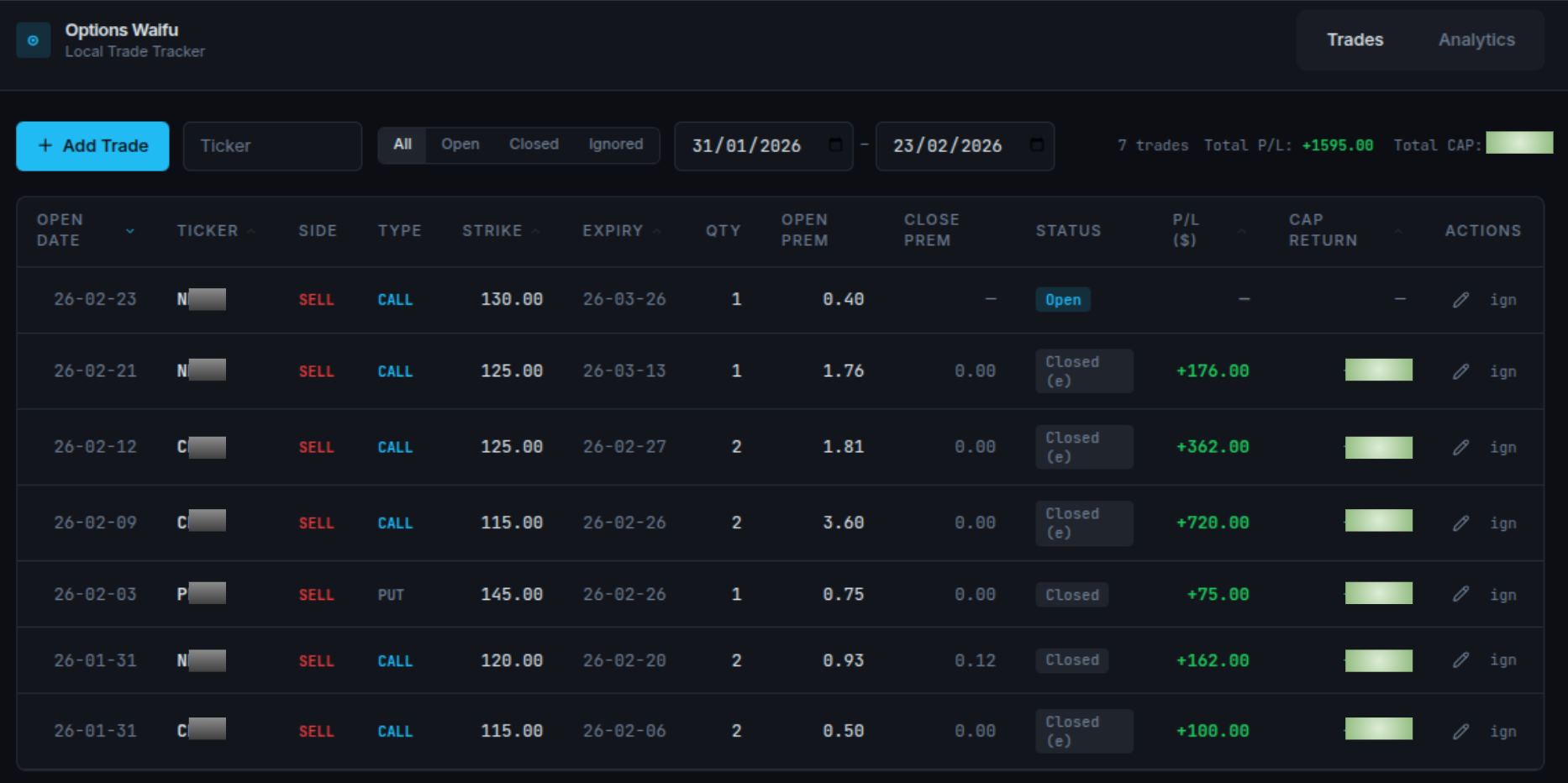
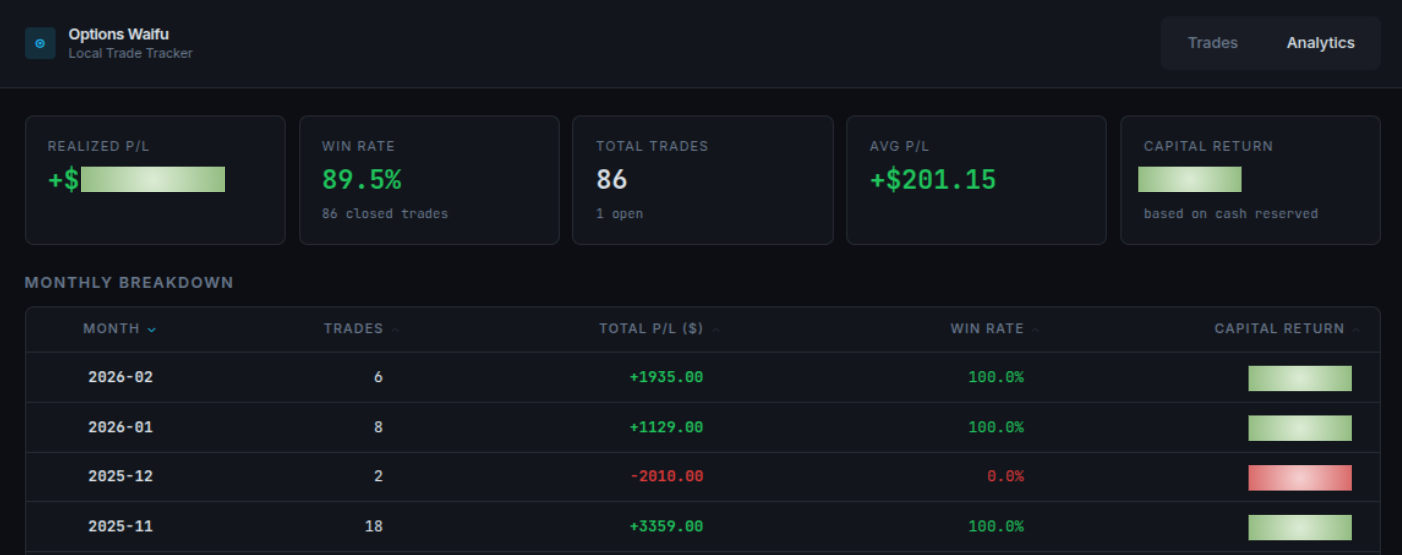
Phase 1 delivered exactly what it set out to deliver. The numbers are real, the system is stable, and the data is clean.
📝 Notes
Phase 1 is intentionally minimal. The foundation is clean and the data model is structured specifically to support future expansion. We did not want OptionsWaifu to derail our main AI projects.
Phase 2 will introduce AI analysis — trade strategy evaluation, pattern recognition across historical trades, and market sentiment overlay. When that layer arrives, it will have clean, structured data to work with because Phase 1 didn't cut corners on the schema.
Build the data right first. Let the intelligence come second.
✅ Conclusion
OptionsWaifu does exactly what she was made to do. Trades are tracked. Analytics are accurate. The question "what's my win rate this month?" now has a reliable answer. (Hint: ~25% for 2025. ok that’s decent lunch money.... 4 days of dev to get this info zzzz...) Mission accomplished.
🚀 Future Improvements
- Stock trade tracking
- Chart visualizations
- Monthly performance reports
- CSV export
- Auto price lookup
- Broker import
OptionsWaifu is still evolving. But for the first time, it’s clear.