
Rebuilding the Lab Notebook: From Hardcoded Blog to Chronicle CMS
🎯 Objectives
Replace the original hardcoded blog workflow with a CMS-based system that enables fast, repeatable, and low-friction publishing.
⚙️ Previous System (Baseline)
The original site was built as a frontend-first React + Vite application deployed on Vercel.
Content handling:
- Article metadata stored in local source code
- Full article bodies embedded inside large React components
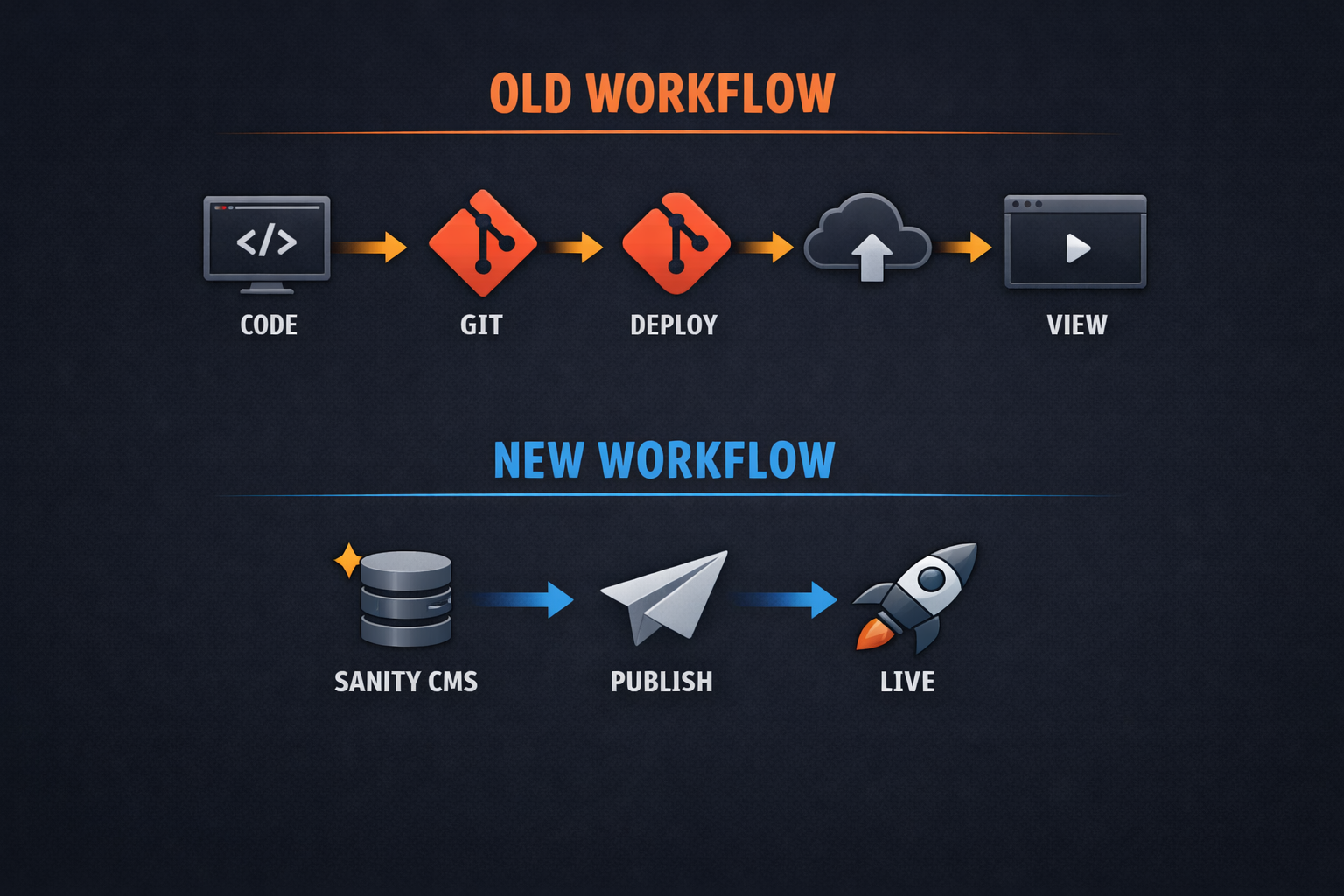
- Publishing required code edits + Git + deployment
This created a developer-dependent workflow for writing.
The original frontend structure was generated using AI-assisted tooling. What launched quickly became difficult to maintain — the architecture prioritized speed of generation over long-term usability. The rebuild was not planned. It was necessary.
🔥 Problem
The issue was not visual design — it was publishing friction.
A single article update required:
- Editing code
- Manual formatting
- Image placement adjustments
- Commit → push → Vercel deploy
This caused the site to behave like a software project, not a lab notebook.
🛠️ Architecture Change
To remove this friction, the system was rebuilt with a CMS-first model.
Changes:
- Introduced Sanity CMS as content backend
- Defined structured post schema
- Implemented AI Lab categories (Experiments, Projects, Field Notes, Archive)
- Migrated rewritten articles into CMS
- Connected frontend routes to Sanity data
- Replaced hardcoded content with dynamic content pipeline
The CMS layer was codenamed Chronicle internally. A lab notebook should feel like one.
⚙️ New System
Current architecture:
- Frontend: React + Vite
- Hosting: Vercel
- Content backend: Sanity (Chronicle)
Data flow:
Sanity (content)
→ frontend fetch
→ rendered pages (listing + article)
Publishing model:
- Frontend changes → Git + Vercel
- Content changes → publish in Sanity (no deploy required)
⚙️ Observations
The key issue with the original system was coupling writing with code.
The new system separates:
- Content management (Sanity)
- Presentation (frontend)
This reduces friction and improves scalability.
📊 Results
Current state:
- Chronicle CMS running ✅
- All articles stored in Sanity ✅
- Homepage and article pages dynamically rendered ✅
- Hardcoded blog architecture removed ✅
Publishing is now:
write → publish → live💡 Key Learnings
- AI-assisted tooling can accelerate frontend structure, but does not solve publishing workflow design
- A publishing system fails if writing feels heavier than building
- CMS separation is critical for long-term sustainability
- Structured content scales better than embedded code
- Taxonomy and site identity matter as much as tooling
- The right architecture is the one you can actually use — not the one that launched fastest
📝 Notes
This transition was not a "blog redesign." It was an architecture correction.
- The old system proved the site could launch
- The new system makes it usable
🚀 Next Steps
- Improve rendering strategy for machine readability
- Evaluate CSR limitations vs pre-rendered approaches
- Prototype Astro-based static rendering pipeline (Phase 2)
- Validate content visibility via source inspection and link previews
✅ Closing
The old system proved we could launch. Chronicle proved we could continue.
✅ Research team credit:
EthanC + Motoko-chan + Codex-chan + Claude-chan (CEC)+ Lovable-chan, whose early contributions made this rebuild possible.