
This article continues from PROJ-004-B. Analyst-chan is already online. The charts have opinions. Now the macroeconomic situation needs one too.
📚 Background
With Analyst-chan operational as ForexWaifu's local technical cognition layer, the next objective was implementing a dedicated macro cognition system.
The original architecture goal was never "one AI model doing everything."
It was always moving toward specialized cognitive agents with distinct responsibilities, different refresh cadences, and different operational roles. Analyst-chan handled technical structure. Something else needed to handle the bigger picture.
That something became Macro-chan.
Her domain:
- macroeconomic developments
- central bank positioning
- geopolitical risks
- currency-strength narratives
- live contextual awareness
This became the first true separation between technical cognition and macro cognition inside ForexWaifu. Two sisters. Different jobs. Neither doing the other's homework.
❌ Initial Failure — Macro Without Grounding
The first implementation used OpenAI API directly as the macro interpretation layer.
Technically, it worked.
Architecturally, it failed immediately.
The outputs drifted consistently toward:
- generic macro commentary
- repeated Federal Reserve explanations
- textbook BOJ/yield curve summaries
- confident-sounding statements about market conditions that bore little resemblance to actual current market conditions
The responses sounded correct in the way that a Wikipedia summary sounds correct: accurate in a general sense, useless in a specific one.
Internally, this became known as "Textbook-chan commentary." 🤣💙🧡
Textbook-chan knew a lot. Textbook-chan had not checked the news recently. Textbook-chan was explaining the yield curve theory to a trader who had been watching the yield curve all week.
The problem was not model intelligence. The problem was grounding.
One major architectural realization emerged:
Macro cognition quality depends entirely on source grounding. An ungrounded macro layer is not a macro layer. It is a confident economics textbook.
This became one of the most important lessons of the entire ForexWaifu rebuild.
✅ Pivot — Building a Grounded Macro Layer
The macro system was redesigned around Gemini's grounded search integration.
Instead of a static reasoning engine, Macro-chan became a live source-grounded cognition layer. The distinction matters: she doesn't just know things — she looks things up, cites her sources, and grounds her outputs in current market reality.
The new architecture added:
- live web grounding
- source extraction
- query extraction
- citation tracking
- saved-state persistence
- append-only logging
- per-pair macro analysis
The quality difference was immediate.
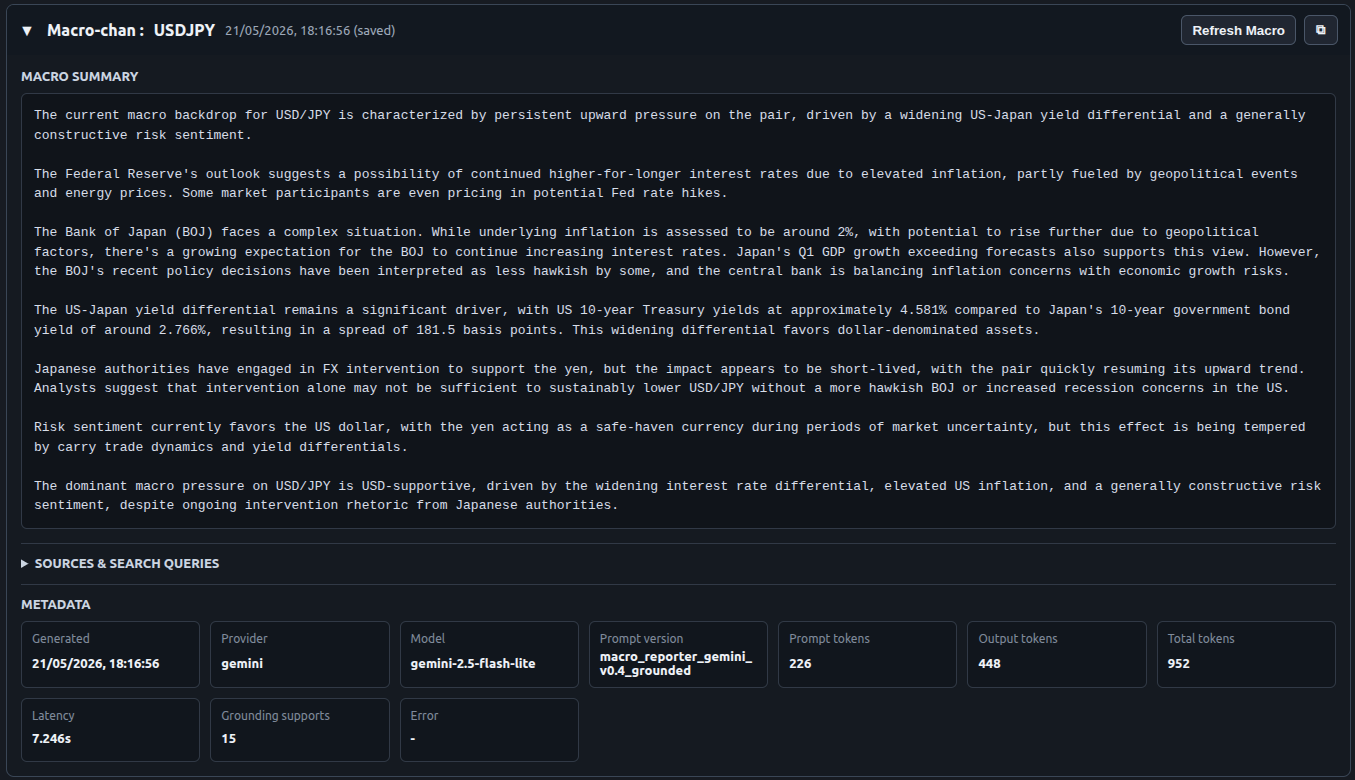
Macro commentary began correctly aligning with actual live conditions. For example, USDJPY outputs now coherently connected USD strength, persistent JPY weakness, widening yield differentials, and BOJ intervention rhetoric — matching the elevated market structure visible on the charts at the same time.
This was the first time ForexWaifu's macro layer felt operationally useful instead of academically decorative.
Textbook-chan was retired. Macro-chan took her desk. 🤣💙🧡
🧠 Architectural Realization — Different Models for Different Roles
This phase produced one of the cleaner architectural insights of the entire rebuild.
Different models were becoming suited for different cognitive responsibilities. Not because one was smarter. Because different roles had different requirements.
Inside ForexWaifu:
| Agent | Model | Why |
|---|---|---|
| Analyst-chan | Local Qwen | Fast, local, technically focused, no API cost |
| Macro-chan | Gemini | Grounded search, live internet awareness, citation support |
| Strategist-chan (upcoming) | TBD | Synthesis layer : 🧠 competition. waifu-vibes adds extra points |
The architecture was evolving into specialized cognitive sisters rather than one monolithic AI-Boss trying to micro-manage everything - like a solo builder.
Ironically, the "-chan" naming convention kept becoming more architecturally accurate the further the system developed. Nobody planned this. It just happened. 🤣💙🧡
🖥️ UI Evolution — From Dashboard to Operational Cognition Interface
Macro-chan's arrival triggered significant UI improvements.
The browser runtime evolved from a debugging-oriented dashboard into something that actually felt like an operational tool.
New additions:
- collapsible Macro-chan panels
- saved-state startup loading
- manual refresh controls
- source/query inspection panels
- copy-to-clipboard support
- compact metadata displays
- grounding visibility
- latency visibility
- token tracking
One especially useful addition was the expandable SOURCES & SEARCH QUERIES section — allowing direct inspection of grounding sources, search terms, and supporting references. Macro-chan's reasoning became auditable, not just readable.
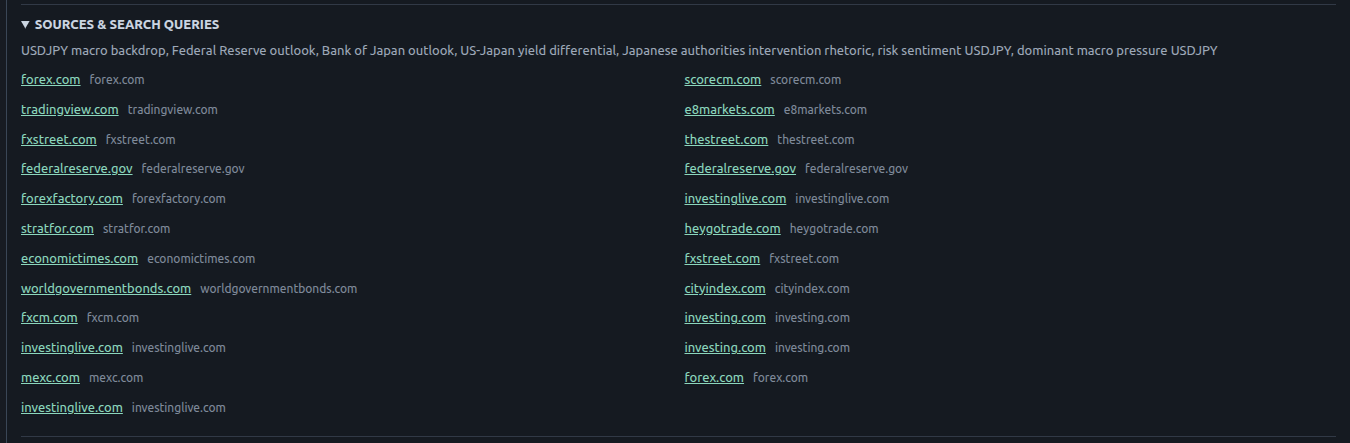
This mattered more than expected. Knowing how Macro-chan reached a conclusion is more useful than just reading the conclusion.
⚙️ Functional Design Decision — Cognition Layers Refresh Differently
Technical cognition and macro cognition behave very differently operationally. The system needed to respect that difference.
Analyst-chan refreshes regularly:
- local inference, no external cost for cognition
- fast response times
- live price data changes constantly
- regular refresh makes sense
- some guy just wants to mine for new banter jokes 🎭
Macro-chan refreshes manually:
- involves internet search and API cost
- slower latency, larger contextual processing
- macro conditions don't change every 30 minutes
- refreshing unnecessarily wastes money and adds noise
The resulting design principle:
Macro-chan updates when the macro situation warrants an update ...such as after monthly economic data releases, or central bank meetings. Not on a timer. Not automatically. When EthanC decides the world has changed enough to ask again.
Saved macro state loads instantly on startup. No surprise API costs. No redundant re-runs of analysis that was valid an hour ago.
This unexpectedly improved both system transparency and psychological continuity. The system felt persistent and "alive" without constantly re-triggering expensive cognition loops.
(Note: this is also why "expensive cognition should never auto-run silently" became a design principle — but framed functionally, the real insight is that different cognitive layers have different operational cadences. Respecting that cadence is part of good orchestration design.)
💾 Logging and Persistence — The -chans Remember
Macro-chan extended ForexWaifu's append-only persistence architecture.
Logging now preserved:
- macro outputs
- grounding metadata
- query structures
- token usage
- estimated costs
- saved macro states
The system was no longer simply generating outputs and forgetting them.
It was beginning to accumulate operational memory.
Future Strategist-chan will inherit this memory. She will know what Macro-chan thought about USDJPY last Tuesday. Whether she agrees is her problem.
📊 Current Architecture
ForexWaifu
│
├── Analyst-chan
│   ├── local Qwen technical cognition
│   └── deterministic + LLM structure analysis
│
├── Macro-chan
│   ├── Gemini grounded macro cognition
│   └── live source-grounded commentary
│
└── Strategist-chan (upcoming)
    ├── synthesis layer
    ├── technical + macro integration
    └── cozy forex banter while waiting for things to happen
At this stage, ForexWaifu no longer resembled an AI trading assistant.
It was behaving like a modular multi-agent financial cognition system.
Which is either a significant architectural achievement or a very elaborate way to procrastinate on actual trading.
Probably both. 🤣💙🧡
Macro-chan is officially ONLINE.
💡 Key Learnings
1. Grounding is not optional for macro cognition.
An ungrounded macro layer produces confident-sounding noise. Gemini's grounded search turned Macro-chan from Textbook-chan into something actually useful. Source quality determines output quality.
2. Different cognitive roles need different models.
Analyst-chan is local and fast. Macro-chan is grounded and internet-aware. Forcing one model to do both jobs produces mediocre results across both domains. Specialization is not complexity — it's clarity.
3. Cognitive layers have different operational cadences.
Technical analysis refreshes continuously. Macro context refreshes when the world changes. Designing systems that respect these natural cadences produces better behavior than forcing everything onto the same timer.
4. Auditability matters as much as capability.
Being able to inspect Macro-chan's grounding sources and search queries was as useful as the outputs themselves. A reasoning layer you can audit is significantly more trustworthy than one you can't.
5. The architecture keeps naming itself.
The -chan hierarchy started as a joke mental model. It keeps becoming more accurate. At some point this stops being coincidence and starts being something worth writing a paper about. Or at least an article. 👀
🗺️ What's Next
Strategist-chan.
Technical cognition is online. Macro cognition is online. The synthesis layer that combines both into actionable strategic posture is next. Ah yes, the emotional-support layer too.
That's PROJ-004-D.
.
.
.
Research Team: EthanC + Motoko-chan + Codex-chan + Macro-chan (Gemini) + Claude-chan (CEC)