
📚 Background
Following the realization documented in PROJ-004-A, EthanC with the help of Motoko-chan, began rebuilding ForexWaifu Phase 2 as a practical multi-agent experimentation platform.
The objective was not to build a full autonomous trading system.
The goal was more specific:
- modernize the runtime architecture
- migrate away from CLI-first workflows
- establish a browser-based operational interface
- separate deterministic and cognitive systems cleanly
- get the first specialized agent online: Analyst-chan
Surprisingly, the migration was completed within a single day.
This happened largely because the original 2025 ForexWaifu architecture already contained many proto-agent concepts in various states of accidental correctness. The realization from PROJ-004-A had one practical consequence: ForexWaifu did not need a rewrite from zero. It needed reorganization into clearer layers.
This is a much more enjoyable kind of project than starting from scratch. Highly recommended. 👍
⚙️ Phase 2A — Browser Runtime Migration
The original CLI approach worked adequately during early experimentation. Then multiple cognition layers started appearing and everything became significantly less adequate.
Problems with CLI-first:
- difficult state visibility across pairs
- no operational overview
- awkward navigation between outputs
- weak orchestration visibility
- general feeling of operating in the dark
The browser runtime fixed all of this immediately, which was either a sign that the migration was the right call or a sign that the CLI setup had been quietly suffering for longer than anyone admitted.
Probably both.
The rebuilt architecture introduced:
- frontend/backend separation
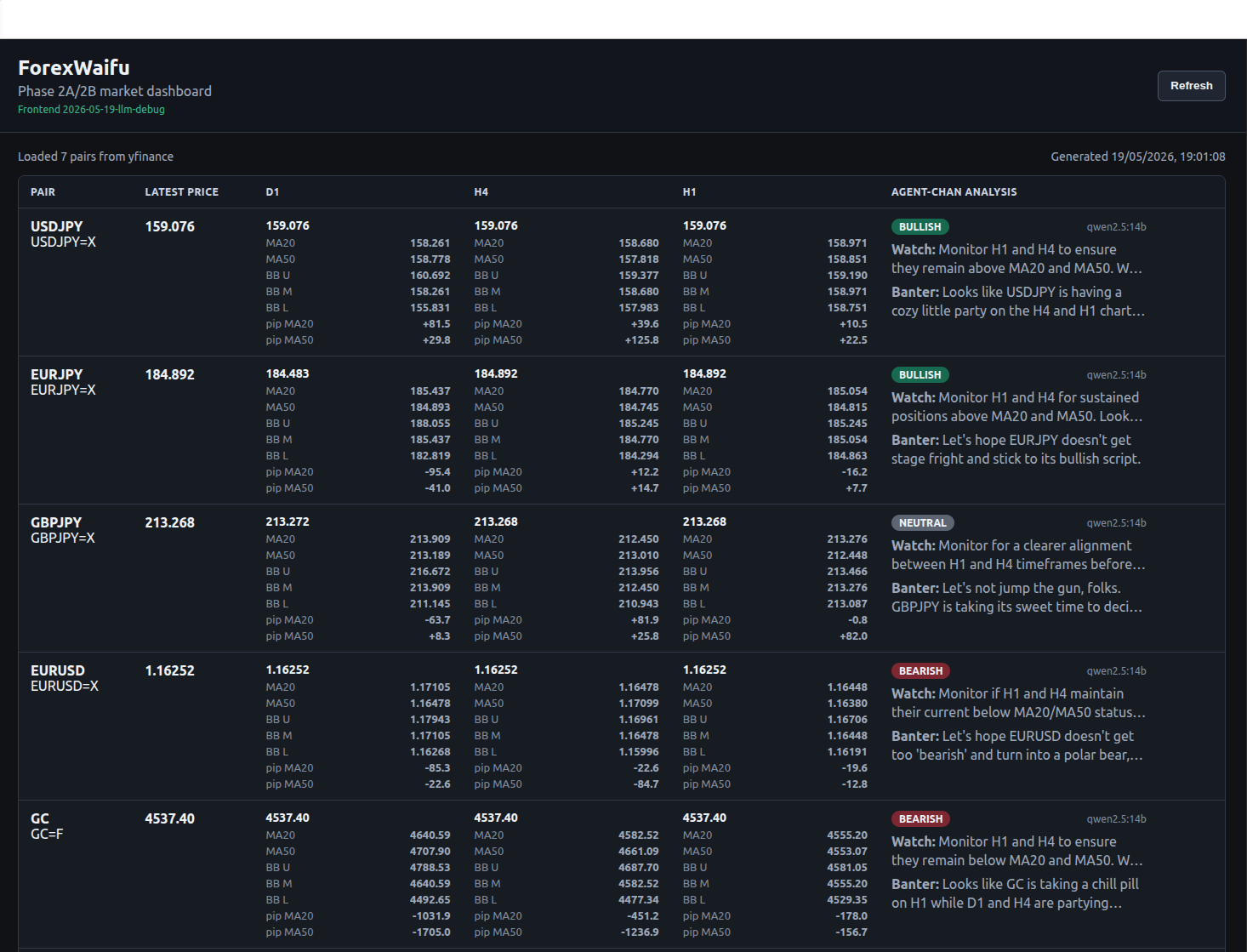
- lightweight browser dashboard
- pair tables with D1/H4/H1 structure displays
- backend API endpoints
- runtime visualization
The resulting system felt significantly more "alive" operationally. This is not a technical term. It is, however, accurate.
📋 Pair Doctrine Simplification
Phase 2 also involved a deliberate reduction in scope.
The older system tracked more pairs than necessary and generated more signals than useful. Phase 2 fixed this.
Tier 1 — Primary Pairs
- USDJPY
- EURJPY
- GBPJPY
- EURUSD
- XAUUSD
Tier 2 — Context Pairs
- SGDJPY
- USDSGD
The reasoning: focus on pairs with stronger familiarity, cleaner execution behavior, and historically better decision confidence. Cut everything else. (Also shows how many pairs EthanC can track properly at 1 time.)
Many older signal-generation systems were intentionally removed at the same time. Instead of producing excessive automated signals that would then need to be ignored, the new architecture focuses on raw market structure, contextual interpretation, and cleaner strategic reasoning.
Less noise. More signal. The irony of a signal system that works better with fewer signals was noted and filed away.
Goodbye 🍖 and 🍔 - (ref: PROJ-001)
🏗️ Deterministic vs Cognitive Separation
One of the most important architectural decisions in Phase 2 was formally separating the deterministic layer from the cognitive layer. These two things are not the same and should not be treated as the same.
Deterministic layer handles:
- market data
- moving averages
- Bollinger Bands
- structure calculations
- derived labels
- timeframe bias
- support/resistance context
This layer is mathematical, reproducible, and predictable. It does not have opinions. It does not have feelings. It simply calculates.
Analyst-chan operates as the cognitive interpretation layer above it.
Her responsibility is not to calculate indicators. Her role is to interpret structure:
- trend cleanliness
- structural confidence
- watch conditions
- execution caution
- contextual observations
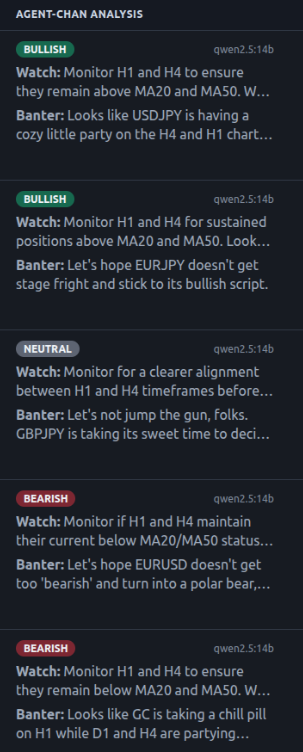
- and also very important : lightweight trading banter 🤣
This separation dramatically improved architecture clarity. The deterministic layer retains the market data. Analyst-chan decides what it means.
These are different jobs. Keeping them separate was one of the better decisions of the entire rebuild.
⚙️ Phase 2B — Agent Packet Layer
Once the deterministic pipeline stabilized, ForexWaifu introduced /api/agent-packets.
This became the transformation layer between raw market data and cognitive interpretation — the point where structured numbers became structured context that a reasoning layer could actually interpret efficiently.
Instead of feeding raw candles and indicator arrays directly into the LLM, the deterministic layer pre-processed market structure into compact “agent packets” containing:
- MA relationships
- timeframe alignment
- trend posture
- Bollinger positioning
- structural confidence metadata
This created an important architectural separation:
raw market data
→ deterministic structure extraction
→ cognitive interpretation
In hindsight, this was an early form of cognition-layer orchestration emerging naturally from the system design.
The LLM was no longer acting as a pure raw-data parser. It was operating as a higher-level reasoning layer sitting on top of a structured analytical substrate.
That distinction became far more important than it initially appeared.
🧠 Analyst-chan v0.1 → v0.2
Analyst-chan came online in two stages.
The first stage was deterministic — structured logic producing analyst-shaped outputs with no LLM involved. This phase focused on validating the packet structure, technical interpretation flow, and output formatting before introducing cognitive complexity.
Outputs included:
- directional bias
- structural confidence estimation
- watch/no-trade conditions
- risk observations
- simplified commentary
One important realization emerged during testing:
confidence did not represent trade-win probability.
Confidence represented structural cleanliness.
A high-confidence reading meant the market structure was clean and readable — not that the trade would succeed. The market remained entirely unaware of Analyst-chan’s confidence scores and continued doing whatever it wanted regardless.
This distinction became critically important later for preventing misleading downstream interpretation.
The second stage integrated Qwen locally via Ollama.
This created the first true local cognitive loop inside ForexWaifu:
yfinance
→ deterministic indicators
→ agent packets
→ Analyst-chan (local LLM cognition)
→ browser visualization
→ persistent logs
For the first time, ForexWaifu could:
- observe structure
- transform context
- interpret conditions
- visualize cognition
- preserve operational memory
entirely locally, inside a browser runtime.
No cloud cognition required.
This was the first genuinely operational proto-agent cognition loop in the system.
It was also when Analyst-chan developed a personality.
The outputs stopped being merely templated and started becoming reasoned. More unexpectedly, the commentary became emotionally pointed during testing sessions. The charts were not just analyzed. They were judged 🤣. The user was occasionally implicated in the judgment.
Somehow, the system became significantly more enjoyable once the charts started having opinions about the human reading them.
This finding was unexpected.
It is now a design principle. 🤣💙🧡
💾 Logging and Persistence
Phase 2 introduced append-only logging across:
- market snapshots
- agent packets
- analyst outputs
- LLM outputs
Artifacts preserved as timestamped JSON with no overwrite behavior, model/version tagging, and replay capability.
This became the first true persistence foundation for ForexWaifu's future memory systems. Future-Analyst-chan will be able to look back at what Past-Analyst-chan thought about the same structure.
Whether she will agree with her past self is an open question.
💡 Key Learnings
1. Existing architecture mattered more than expected.
Migration was fast because the conceptual foundations already existed. The project wasn't rebuilt from nothing — it was reorganized into clearer layers. Good early architecture decisions are invisible until you need them. Then they are very visible. See also: ARCH-005.
2. Simpler systems produced cleaner cognition.
Reducing excessive signals, unnecessary pair tracking, and overloaded logic improved operational clarity significantly. The system got smarter when it was asked to do less.
3. Browser runtime dramatically improved orchestration visibility.
Comparing pairs, navigating cognition layers, observing runtime state — all of this became substantially easier once the interface existed to support it. This seems obvious in retrospect. It was not obvious at the time.
4. The deterministic/cognitive separation is not optional.
Feeding raw market data directly into an LLM produces worse results than feeding structured contextual packets. The transformation layer is doing real work. The agent packet architecture earns its complexity.
5. The waifu layer improved usability in ways that are hard to quantify and easy to dismiss.
Analyst-chan's banter during long testing sessions was not decorative. It was functional. A system that has opinions about what it's observing is more engaging to work with than one that doesn't. This is either a profound insight about AI system design or evidence that EthanC has been alone with his workstation for too long.
Probably both.
📊 Current State
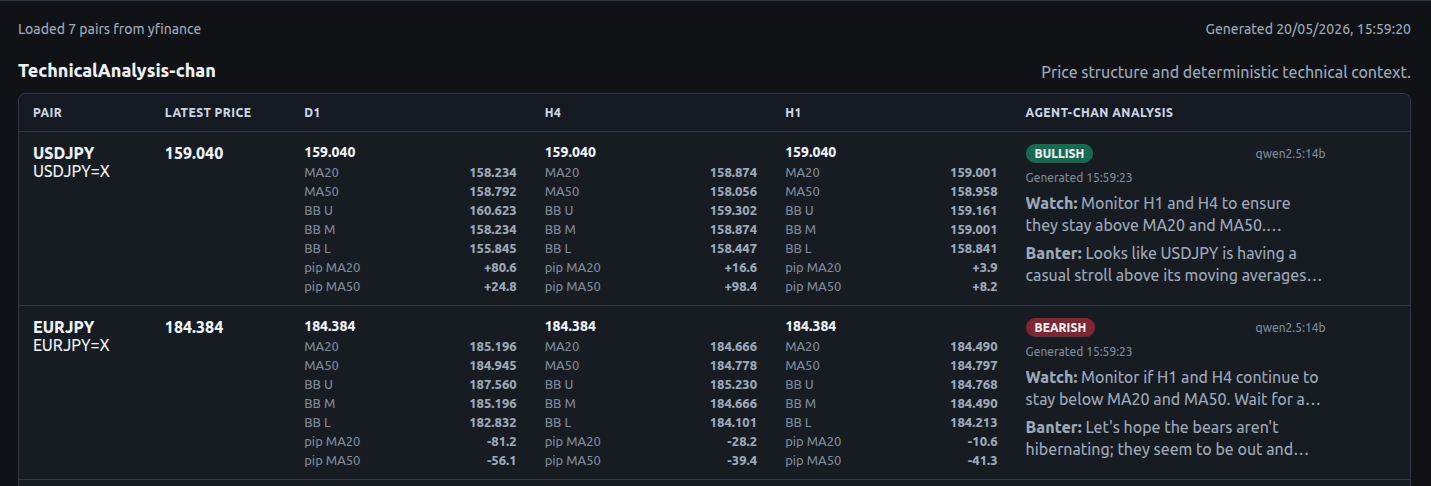
ForexWaifu Phase 2B now contains:
- browser runtime architecture ✅
- deterministic market engine ✅
- structured agent packet layer ✅
- local LLM cognition (Qwen via Ollama) ✅
- Analyst-chan v0.2 ✅
- modular orchestration foundation ✅
Most importantly: the system now feels operational.
🗺️ What's Next in This Series
PROJ-004-C : Macro-chan Online — Building a Grounded Macro Layer
.
.
.
Research Team: EthanC + Motoko-chan + Codex-chan + Claude-chan (CEC)